
In preparation for International Women’s
Last year I struggled to write posts on both Endometriosis, a health condition affecting only women, and a post for International Women’s Day. I believe that what got in the way of both was my anger at the inequality that is not only still very prevalent in the West but reinforced by other women. My anger, bitterness and sadness about unequal attitudes to women and men is because I know the health and psychological costs of inequality. I have long believed for example that implicit behavioural codes and expectations prevent women from expressing or owning anger, as I have struggled to do, and men are disallowed from expressing tears. I see and hear these attitudes and rules put into place not just on social media, in advertising or in films but in the mouths of people I know – I once witnessed someone say to a crying little boy, “man up”. The damage these gendered codes of behaviour have is stress, stress from holding in emotions that absolutely need an outlet and stress from hiding a great part of who we are. Stress leads to a host of chronic health conditions.
“Stereotypes keep power where it is”
In terms of the personal cost of conforming to gender stereotypes either consciously or through learning we can end up being completely split within ourselves. We can end up unable to completely accept ourselves despite our brilliant uniqueness and transience. Stereotypes cause an enormous amount of toxic emotion like shame or guilt, and in my mind no one on earth deserves to feel crap about the way they want to exist in the world. Exploring the roots of gender stereotypes would take me longer than this little blog and would be a fairer exploration of the topic; I might consider for example what gendered behaviour is there by nature not nurture. I do believe that a lot of gender stereotypes, and stereotypes in general, are to do with keeping power where it is, they are created by Governments and wealthy companies to keep those in power in power. For those who might be interested in how the promotion of stereotypes function to control society I recommend the BBC documentaries HyperNormalisation (2016) or Century of The Self (2002), both by Adam Curtis.
I have struggled as a woman despite much hard work to live and play in this world freely due to stereotypes about women. I have overcome anorexia, body dysmorphia and most negative attitudes towards my own body but I have to work at it. Daily, it seems, I am inundated with images of how I should look and be in this world, I am told to have it all and that if I don’t have it all I am not enough. Most of my life it has felt that life was already written for me, that there is a set path society expects me to walk. Women are most definitely under more pressure than men not only to do it all, the job, the kids, the cleaning but to do it all looking yoga ready and beaming all the time. This is utter bull crap. Most women I know are really struggling under the pressure to do it all, be everything to everyone and they are not beaming! Why are the women not beaming? They are not beaming because women are mainly told to put up and shut up not just by men but also by women. Women are judged daily for every single choice they make as this brilliant video by The Daily Mash observes, and despite years of progress women still don’t own either their bodies or minds. Women in the West may have got the vote and may not be banished outside because they have their periods but really are things that much better for women in the West?
Until the last few years in my life I hadn’t felt the pervasiveness of patriarchal oppression for a while, but it came. The moment I got married I was asked, “When are you having kids?” not will I have kids but when. A few years later I was diagnosed with a condition only effecting women which had gone undiagnosed for 10 or more years: Endometriosis. Attitudes towards women’s pain and women just accepting it because they are female in my opinion is one of the reasons women do not get diagnosed quicker with Endometriosis. Women hear “Oh it’s just your period”. I absolutely hate the word just which is often used to deny and invalidate the experiences of not only women but also men. Women will be told “it’s just your period, it’s just your hormones”. Actually, it is better to say “it is your hormones, it is your period”, it is your experience and there is no just about it. I am not saying that we need to be victims to our experiences but there is very clear difference between a woman accepting these experiences and a woman thinking she has no reason to be unhappy about pain or problems in her life. Denying there is a problem can often be as much of a problem as over focusing on a problem, neither lead to a solution, they lead to a struggle and a struggle is the root of most emotional issues.
“It is your experience and there is no just about it”
The word just, used in this way, has a negative connotation and to me is about silencing a woman’s voice in expressing her needs. The fact is that in the West we don’t send women into the cold with their periods, but we do refuse to talk period! There is a whole range of needs, experiences and wishes that fall silent for women as they go from very young women through adulthood. Women are still hiding parts of themselves because they are asked to or they face stonewalling when speaking about certain topics; for a lot of women both periods and miscarriages are off the table. When a topic is taboo a person is left experiencing something in isolation, full of fear, and maybe experiencing shame because they don’t understand how common something like a miscarriage is. It seems to me that from the moment a girl hits puberty, or maybe even earlier, her range of choices and freedoms become narrowed not by obvious control but through absences in education, parental choices, media exposure or maybe the words or silences of friends.,
There are many other areas where I feel that inequality shows up but at the moment it is highlighted in a few key places for me. First, in terms of Endometriosis, there might be more research done in this area if there were more women in medicine and science. Second is the myth perpetuated by the media, wellbeing and beauty industries, along with key figures like Donald Trump that a woman’s power or worth is tied to how she looks. This is fundamentally disempowering and places ownership of a woman’s body into the hands of society rather than where it should be: inside the woman. A very good example of how women are only presented as being acceptable in a narrow way is to search around for commercial or stock images in beauty or wellbeing and see how many women you find over 35. The idea that a woman’s worth declines after 35 because apparently her physical beauty declines is so pervasive in society and utterly repulsive to me. This myth is absolutely oppressive and denies everything else that a woman has to offer.
“Stereotypes force us all to play roles”
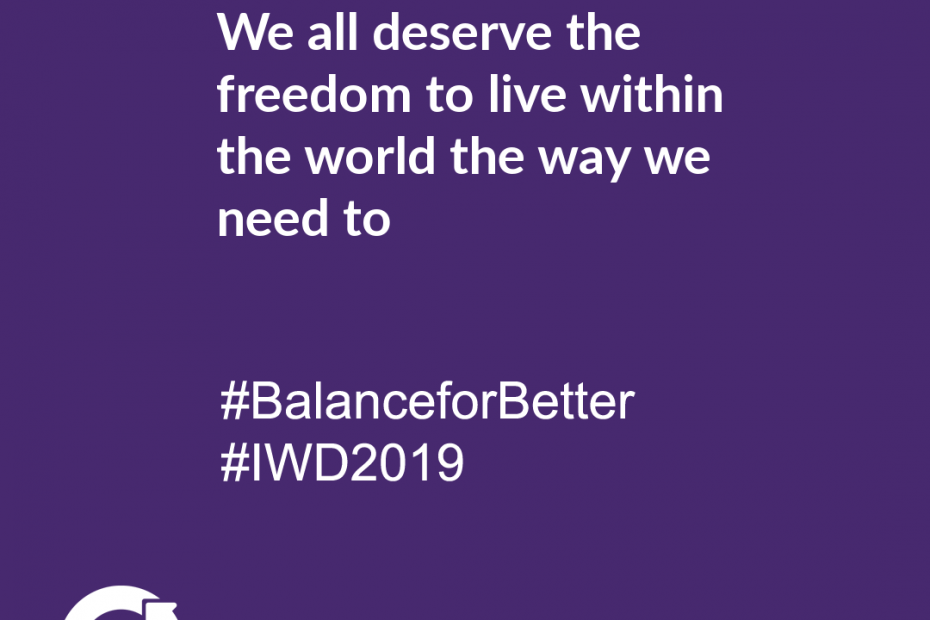
It is International Women’s Day but it is worth considering that gender stereotypes limit those identifying as men, those identifying as women and those in between. Stereotypes force us all to play roles and silence parts of ourselves, we are not separate from a stereotype just because it affects females and we are male. We define ourselves through what we are not – male/female, abled/disabled, etc. – and how we interpret ourselves is influenced in part by stereotypes. We all deserve the freedom to live within the world the way we need to as long as we do no harm to others. We all have a responsibility to challenge negative stereotypes so that people are able to live in freedom, being open about who they truly are, are able to accept themselves and able to be accepted by society. I believe women have come a very long way in fighting stereotypes of women and fighting for equality but there is still progress to be made. A great deal of progress might be made by women confident enough to accept themselves, as they are, without judgement and leading the way for other women.
I will end on a positive note and a conundrum. I really struggled here to describe the pressures women can be under without my own assumptions of what it means to be female and have female experiences and what it means to be male and have male experiences. I don’t necessarily subscribe to binary interpretations of lived experience and I am not “traditional” in my views of what is a woman and what is a man. The experiences I have picked out as experiences of oppression as a woman are my perception and ignore for example those of transgendered or asexual women with whom I will have some things in common and some things I won’t. I will have missed a great swathe of oppressive experiences women have had. My positive note is that I generally wish however people identify themselves that they are able to live in this world with choices, self-acceptance and societal acceptance which means over all, freedom.